Monday, November 12, 2012

SHITTY NOVELS

Hit Lit: some deleted parts.

In the five years I spent working on Hit Lit, I had many false starts, and very many drafts. I was fortunate to have an absolutely fabulous editor at Random House who understood the book very well and was extremely enthusiastic. 

The idea I had originally was to use the book as an opportunity to make a case against snobbery, and for popular fiction. My tone was somewhat confrontational, definitely provocative, and finally it was determined to be too off-putting to the kinds of readers that Random House wanted for Hit Lit. They thought the book should present a positive portrait of the 12 bestsellers I was focusing on. It should be about the reasons why so many people LOVE these books, not why so many people MOCK THEM OR PUT THEM DOWN. 

I thought I could do both things in the same book, and I fought to hold on to that original premise for a long time. However, in the end, I was convinced to cut those sections (a quarter of the book) and to soften my tone elsewhere. 

My first version of Hit Lit was far edgier than it turned out to be. Far more likely to have stirred controversy than it did. The final version was softer and more generic than I had originally wanted it to be, but I fully understood the editorial and marketing issues involved in my publisher's point of view. 

 In any case, now that the book is published, I thought it might be fun to use my blog (from which I have been absent for many months) to use as a repository for some of those sections in Hit Lit which I spent a great deal of time on originally, and then spent a great deal of time defending, then spent a great deal of time cutting out. Cutting, by the way, is not as easy as holding down the delete key. 

So, in the next few days (or weeks), I plan to post those deleted sections here.  For those who liked the book or thought it was lacking, this exercise might prove illuminating.


Shitty Novels
“’Best selling’ should not be an accolade so much as a warning.”
Fay Weldon, The Times, 2007


         Every decade or so it happens.  The editor of some prestigious journal decides it’s time again to hire an erudite hitman to write a few thousand caustic words about our nation’s deplorable reading habits—a little Philistine bashing, using the New York Times Fiction Bestseller List as the target.   Wonder if Gore Vidal is busy?
         Well, in 1973, Mr. Vidal wasn’t otherwise occupied, though I’m sure the writers of the ten novels unlucky enough to be the most popular works of fiction on that particular week’s New York Times bestseller list probably wished he had been.
         When I was researching my first course in bestsellers, looking for my precursors in this strange new field, I came across Mr. Vidal’s juicy essay, and was thrilled to find myself in perfect agreement with everything in it, including his caustic tone.  He seemed to nail the stance I wanted to take in my course, a gleeful superiority and brutal snarkiness. 
         Using the New York Times list of January 7, 1973, Mr. Vidal let loose his vituperative wit with giddy exuberance and proceeded to disembowel all but one of the ten books that were riding high at that moment.  “Shit has its own integrity,” his essay began and, after establishing in that very first word his own chief descriptor for the material before him, Mr. Vidal moved to his two major points, the first being that “no one ever lost a penny underestimating the intelligence of the American public.”
         This crucial conviction of the literary snob has at least three natural corollaries which go like this:  If a book is popular, it can’t be any good.  And its twin sister:  If a book is truly good, it couldn’t possibly be popular.  And third:  In the unlikely event that a good book does wind up on the bestseller list, it’s an aberration that either indicates some glimmer of “taste” in the untrained reading public, or perhaps more likely, suggests that thousands upon thousands of shoppers bought that specific literary tome mistakenly.
         The belief that popularity and literary value are mutually exclusive so solidly underlies the high culture world view that it forms the invisible and unshakeable foundation of a vast set of prejudices and inviolable assumptions.  For instance, if literary value and widespread popularity do indeed have an inverse relationship, then the bulk of readers in America must be brain-dead drudges who regularly waste their money and time on vapid trash, while the smart guys must be perched on the sublime peaks of Olympus savoring the really good stuff.       
Vidal’s other main point in the 1973 exercise in scorn was to suggest a “corrupt connection” between popular novels and Hollywood films.  “The bad movies we made twenty years ago are now regarded in altogether too many circles as important aspects of what the new illiterates want to believe is the only significant art form of the twentieth century.  An entire generation has been brought up to admire the product of that era.  Like so many dinosaur droppings, the old Hollywood films have petrified into something rich, strange, numinous—golden.”  In other words, shit imitates shit.
         He goes on to refine this thesis by dismissing thirty years of Hollywood films in one flashy sentence.  “I think it is necessary to make these remarks about the movies of the thirties, forties and fifties as a preface to the ten best-selling novels under review since most of these books reflect to some degree the films each author saw in his formative years, while at least seven of the novels appear to me to be deliberate attempts not so much to re-create new film product as to suggest old movies that will make the reader (and publisher and reprinter and, to come full circle, film-maker) recall past success and respond accordingly.”
         Though Vidal’s assertion that these authors were shaped by movies they viewed in their “formative years” is questionable and impossible to prove, the connection between bestselling novels and Hollywood is indeed fertile territory for discussion.  It’s a subject I will return to later.  But first, let’s finish with Mr. Vidal’s amusing essay. 
It’s all great fun to watch trashy novels getting trashed, and Mr. Vidal was certainly the right man for the job.  He is the master of the dismissive one-liner and wields a charming snideness that must have been exactly what the editor at the New York Review of Books had in mind when he put a contract out on those ten bestselling novels.
         Some twenty-one years later, in June of 1994, Anthony Lane, the film critic for the New Yorker again tackled the fiction bestseller list in a pithy and rollicking tone.  Commenting on Vidal’s earlier essay, Mr. Lane strikes a rakish pose.  “Two decades after the Vidal survey, has anything changed?  Well, Solzhenitsyn has gone back to Russia, Mary Renault has died, and Frederick Forsyth is no longer in the top ten.  He is, in fact, at No. 14, with a novel unwisely named The Fist of God.  When he devised the title, it must have sounded crunchy and apocalyptic.  Now it sounds like a club down in the West Village that you can’t get into without a dog collar.”
         Perhaps softened up by his long exposure to Hollywood films, Mr. Lane is more embracing of popular culture in general than Mr. Vidal.  Where Vidal scoffs, Anthony Lane assumes a bemused tone, while still maintaining a finely calibrated distance from his subject matter as though he were turning the pages of these questionable novels with tweezers. 
         “There are sound reasons for musing on this stuff,” he asserts at the outset, sounding like a gastroenterologist about to discuss human excrement.
         His case for studying the bestseller list is, at best, conflicted.  On the one hand he asserts the importance of the exercise.  “It is easy to brush aside best-seller charts as the products of hype and habit, but they are a real presence in the land of letters, generating as much interest as they reflect.  And if they do, to an extent, represent the lowest common denominator of the print culture, this only strengthens our need to pay attention, since where else is that culture common at all?”
         On the other hand, he claims cagily that “the ideal diet consists of trash and classics: all that has survived, and all that has no reason to survive—books you can read without thinking, and books you have to read if you want to think at all.” 
That one man’s trash might be another man’s classic, or that the trash of today can become the classic of tomorrow (and vice versa), never troubles Mr. Lane’s line of reasoning.  “Books you can read without thinking” is his shorthand designation for popular novels, though the fallacies embedded in that definition are boggling.  For instance, what role does the non-thinking part of the reading experience play in Mr. Lane’s value system?  That is, what about human passion—those noble Aristotelian emotions, pity and fear?  Do cerebral matters always trump matters of the heart? 
Yet so sure is he of the correctness of the eternal gold standard he’s using to measure the worth of any literary work, without further ado he blithely embarks on his own mission of ridicule and urbane disparagement.
         Michael Crichton, John Grisham, Clive Cussler, Mary Higgins Clark and Allan Folsolm all wilt under his scornful inspection, while Caleb Carr manages to win this grudging praise, “No. 7 poses a problem.  The Alienist, by Caleb Carr, is a good book  A really good book, swift and dense—popular entertainment that brushes important questions with its fingertips.”  That a book can be “really good” and “popular entertainment” seems to unsettle Mr. Lane and makes him wonder if perhaps people simply buy their books off the bestseller list and read a book like The Alienist without noticing or appreciating its refined sensibility, or its combination of  “the scholarly and the macabre…” 
Ah, yes, there’s Gore Vidal position again.  If a good book somehow becomes popular, the highbrow critic must explain away that success or else his pejoratives about bestsellers in general are called into question.
         Lane saves his best zingers for The Bridges of Madison County  whose vocabulary he attacks as being as bland as the songs of Karen Carpenter and its author as an “unyielding sentimentalist.”  His parting swipe is truly inspired.  “The victorious sales of The Bridges of Madison County make it a more depressing index to the state of America than Beavis, Butt-head, and Snoop Doggy Dogg put together.  I got my copy at an airport, behind a guy who was buying Playboy’s Book of Lingerie, and I think he had the better deal.  He certainly looked happy with his purchase, whereas I had to ask for a paper bag.  This book is worse than embarrassing.  It’s a crock of leavings.”
         What was shit to Vidal is leavings to Lane.  To both of them this has all been an exercise in slumming.  Plug your nose and try to keep your IQ from sinking as you slog ahead through the dreary pages of verbal excrement.  Do your unstated duty and find one or two books on the list that are not quite as insufferable as the rest, but even those must be damned with the faintest praise.
         As I had already discovered early on in my academic career, intellectual condescension can be a heady and addictive sensation.  Setting oneself above the culture at large feeds the ego and in turn breeds a very special satisfaction.  Certainly that’s the excitement I felt as I started that first course in bestsellers.  Even now I can recapture that self-righteous itch as I reread Vidal’s essay and Lane’s.  These are two very smart, very funny men capable of world class putdowns.  
         Though my own smug satisfaction toward bestsellers has mostly evaporated over the last few decades, I remain sympathetic to Mr. Vidal’s and Mr. Lane’s arguments.  It’s not my purpose in these pages to deconstruct their positions or mock their mockery.  They’re right, of course.  
It’s perfectly valid to point out that in American culture a clear demarcation exists between the high road of literary righteousness and the low road of popular success.  And, it’s true, it is the cultural critic’s job to draw and redraw that line from time to time in the brightest Magic Marker available.  For lovers of books, though, it is also a very normal reaction to root passionately for one side or the other of this great divide.  
            But why?


Saturday, April 7, 2012

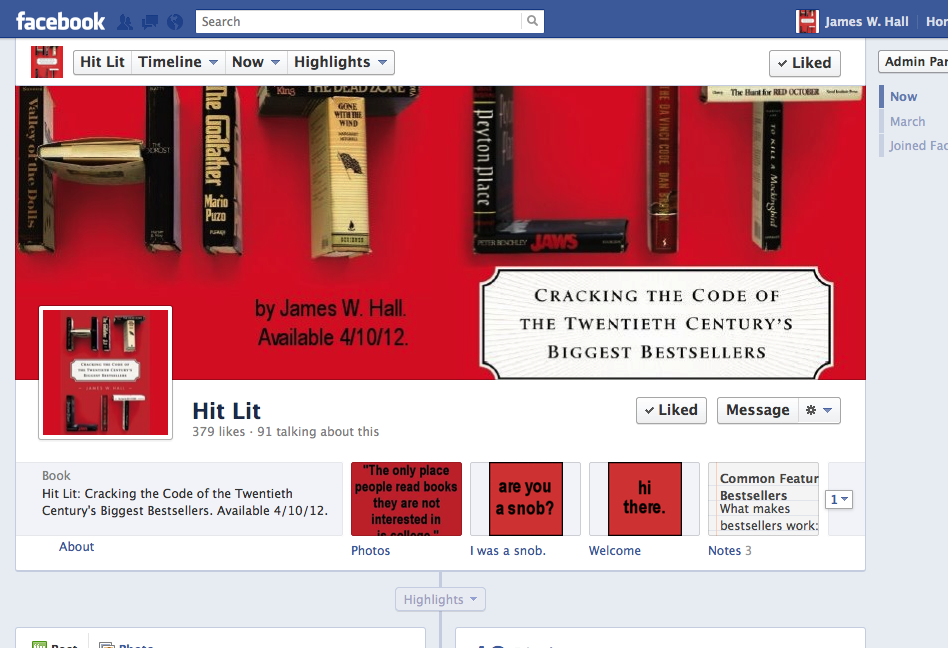
Facebook


I find myself spending more time posting on Facebook and Twitter these days than updating my blog.

So if you want a more up to the minute version of my writing life, thoughts, or a place to leave comments that are more likely to be replied to quickly, join my Facebook page here.

Or you can stop by the Hit Lit page on Facebook by going here. Lots of blog-like postings there and discussions and so on.

Or you can follow me on Twitter: @jameswhall

I'm not abandoning this blog thing because it still feels comfortable and unique. More like journal entries to myself than Facebook is. I know Facebook is public and get feedback pretty quick on postings there. But this format allows me a little more time to think aloud.

How Hit Lit is Different Than Anything I've Ever Done

1. It has an index. I know that may not sound like much. But for some reason I feel like I've written a grown-up book now.

2. Usually it takes me a year or a year and a half to write a novel. It took twenty years to research, five years to write Hit Lit. This one was a long and winding road. I taught the bestseller class to undergrads half a dozen times, and to grad students, both MFA writing creative majors and literature grad students working for their Ph.D. In all those classes, we looked at a lot of bestsellers. Frequently we began the course by choosing our reading list on the first night by picking books directly from the New York Times list.

Then came five years of trying to figure out how to create a book out of a carton full of notes. One of the hardest struggles during this phase was trying to find the right voice. I didn't want it to sound academic or stuffy. I hope I succeeded at that.

3. There is no story, no dialog, no sex or violence, no lyrical descriptions of nature.

4. Once I decided on the twelve novels I would analyze and the twelve recurring features I would discuss, I had to decide how to structure the book. Should each chapter be about a different bestseller, or should each chapter be about a feature? I chose the latter, but a good case can be made for either one.

5. I had to take a stand. In the novels, my characters are usually on all sides of the issues. I try to let characters make the best case for their viewpoint. My own viewpoint might leak through, but it's indirect in the fiction. In Hit Lit I decided (with some serious nudging from my editor) to celebrate these twelve novels rather than make fun of their weaknesses. It was the right decision, I think. I cut away about a hundred pages from an early version that was mostly devoted to making a case against "high culture snobbery." Those hundred pages were acid and biting and snarky. I was mocking the mockers of bestsellers. Most of that is gone. There are traces of my discomfort with certain novels on the list, but for the most part I tried to stay positive about the inherent value of these books. Maybe they're not literary masterpieces, but they're awfully damn good at doing several pretty important things. Like telling a rousing yarn with gripping and emotionally engaging characters.

6. I've always come up with my own titles. Not this time. Some genius (and I mean this honestly) came up with the idea of spelling out the title with the spines of the books themselves. Hit Lit was the result of a graphic decision. And it was brilliant.

7. I've never promoted a book this way before. In the past, with novels, I've gone on the road and given talks or readings at bookstores and libraries. Times are changing, so maybe this difference is strictly a function of a new marketing world, or maybe this book is the reason things are so different this time in the way publicity and marketing works. The campaign for Hit Lit is "media driven" not "event driven." Social media being one of the most prominent ways the word is spread. In the 30 years I've been in the book biz, this is the first time I haven't spent a few weeks on the road promoting it. Maybe it's because I'm getting grumpy in my old age, but I don't mind the change. Except I do miss seeing some of my favorite bookseller friends and the many fans who have become regulars at my events. But hotels, and travel. No, I don't miss that at all.

8. I've never had a trade paperback as the original release. That too might be a function of a changing marketplace. But it seems like the right way to have published this particular book.

9. This is my first time any of my books has had a bright red cover. And not a single dead body in sight.

10. Hit Lit is the first book I've written which I know will never be optioned for film.

Tuesday, March 27, 2012

Finished Books


Starting to get some nice early reviews on Book Blogs here and there.

Here's one.

And here's another.

I got the finished books recently and I'm still smiling. This is the first book I've ever written that has an index. I know that may not sound like much, but it pleases me no end. I feel like a grown-up now.

Writing Hit Lit was the most exhilarating and difficult challenge I've ever taken on. First there was the fact that this was new territory for me. No scenes, no dialog, no action, no character descriptions or descriptions of weather. No narrative.

I had to invent the structure from thin air. Figure out a way to take 20 years of notes and literally piles and piles of books that I'd notated and analyzed and reduce them to some coherent and lucid form. And I had to discover a voice.

A voice for non-fiction! It took me literally months of trial and error to find the sound I wanted. A tone that was not pedantic or professorial but that could communicate some fairly academic premises. Above all I didn't want the book to sound like a goddamn text book.

For assistance with that struggle, I reread some of the pieces I'd written for the Sun-Sentinel Sunshine Magazine many years ago, and that are collected in Hot Damn!

The tone in most of those pieces was wry and self-deprecating. Not an easy voice to sustain for a couple of hundred pages. So struggling with that, and trying to find the form of the book were the hardest early challenges.

But then came the actual arguments, the explications of texts, the logical and orderly progression of my thesis. I'm not, by nature, a logical and orderly person. I never use an outline. I find them limiting and counter-productive. They stifle me rather than liberate me. So I fumbled through the dark for months, and those months became years.

I finally got a hundred pages in and turned in that section to the publisher to show that I was indeed trying to write this book they'd already given me some money for. I spoke to her on the phone and she basically said: start over.

I was so crushed, I put the book aside and didn't get back to it for a couple more years. I thought about it a lot and worked on it in my daydreams, but I didn't write anything until one day my agent called to say that the publisher wanted to know what had happened to the book on bestsellers.

Whoops.

So I got back to it in earnest and wrote and wrote and tried to hone the shape and adjust the tone and keep the whole thing moving affably and smoothly forward.

I turned in a draft about a year ago, and the publisher assigned me a young lady as my editor. Millicent Bennett is her name. I'll always remember her first email to me after she'd read an early draft. It was the most intelligent, most carefully considered, most impressive piece of editing I'd ever read. She wanted me to reshape certain parts of the book. She particularly wanted me to reconsider the harshness of my tone in certain places.

I had gotten a little carried away in attacking what I considered a snobbish sensibility that looks down on bestsellers and mocks them mercilessly. I had mocked the mockers. It was funny but it was also a bit bitter. It took me months to accept that Millicent was right.

I cut away the bitterness, the counter-attacks. I eliminated some of my most bristling defense of the low-road commercial fiction that I was analyzing. Little by little Millicent helped me see that I'd written two books. One was angry at snobbery, the other was gleeful and positive about the benefits of bestsellers. She wanted me to disentangle the two books. She wanted the book to be about my love of reading, and how bestsellers helped me rediscover that after years of academic study.

That feat required cutting away about a hundred pages of text. A job that Millicent assisted me with through every paragraph, every sentence, right down to shaping phrases and choosing better words.

I realized that in twenty-five years I had never been edited before in any way that resembled this. Millicent and I were literally teaming up to write my book.

Just as I finished the final draft, she left the publishing house. Editors do that. I didn't feel betrayed. She'd finished her work with me. My book was done. But I was sad to lose the interaction, the back and forth intellectual engagement. This is one smart woman.

How lucky I was at every stage in the process of creating Hit Lit. More on this later. For the story of the book's inception is one of coincidence and absolute luck.

But the writing of the book was like no other creative enterprise I've ever experienced. I'd like the book to do well in the marketplace, of course, but I can't imagine a better experience in that regard than the one I've already had.

Thursday, March 15, 2012

Okay, so I'm trying to learn how to use Pinterest. It's pretty cool.

Wednesday, February 8, 2012

A few fan photos


Here are a few photos of readers of Dead Last. Send yours to me via the website, and get a free Dead Last hat. Where are all my women fans!!! I know you're out there.

Saturday, January 7, 2012

Dribbling

More reviews come dribbling in. Good, good, and good.

Interesting how so much of everything, including book reviewing, has shifted to cyberspace. I suppose the upside of that is longevity. If a review is good, that is. It'll stick around forever, or as long as electrons still have a say in it. Of course, the bad reviews stick around forever too.

I've been struck on this book (literally) by how many nasty comments have been made by reader/reviewers on Amazon and elsewhere. Sometimes I've taken a moment or two to read some of the other reviews written by particularly mean-spirited readers of my book. (At least they say they've read it.) Often it turns out that this reviewer either: a)has never reviewed a book before (which is a bit strange and slightly suspicious) or b) has never given anything above 1 star to 90 percent of the books reviewed, except for books featuring Navy SEALS or Zombies or cat detectives.

But the professional reviewers, by and large, have been very kind and thoughtful with DEAD LAST, as these reviews show.

Crime Book Beat rates the books with a complicated numerical value system. Weird, but I must say I'm happy to land in the 80's.

Then there's BookReporter which has been around for a while and is a solid and reliable source of book reviews.

And finally I found Nights and Weekends, a site I've not come across before, but one which obviously has sterling good taste in books.

Though it's tempting to sit at my computer all day and Google my name to see what new reviews have come in, I've actually taken good long breaks away from my Mac. For instance, this week I went shooting at the gun range with my very reliable .357 Smith and Wesson. Last time I shot at a Bin Laden target and filled him with holes, but that target has mercifully been retired. This time I shot Zombies. The target was ten yards away, and as you can see, I never hit the lovely but endangered young lady once.


Thursday, January 5, 2012

At the Gun Range


Spent a relaxing hour at the gun range this morning. Tuning up my aim on a silly target. But it does give me some confidence I can defend my loved ones if the time came. This is with my .357 Smith and Wesson from 7-10 yards. Didn't hit the innocent lady once.

Tuesday, November 29, 2011

Books and Books: Twenty-five Years and It Never Gets Old


Mitch Kaplan gave me a wonderful introduction last night. There is, as Mitch discovered, another James W. Hall, a former military guy who turned spy against the US, and is now serving time in prison. Apparently some websites on the Internet have conflated the spy and me. Pretty funny.

Mitch reminded the audience that he's been in the independent book business for 30 plus years and he and I have been doing this song and dance for most of those. Thank god for that.

The photos of the event were taken by my friend Michael Stern. Sternphotos.com. Check out his amazing website. He's a great nature photographer, specializing in Florida. But occasionally he'll come indoors and snap the wildlife running around in the stacks.

This is Mitch Kaplan and me sharing the podium.


And here I am promoting my short story collection. Available for your Kindle or Nook.


Here are some interesting readers getting their books signed. I've got great fans. So smart, so funny. They don't let me get away with much.


Here's some of the audience. This shot taken by Evelyn, my lovely wife, who had one of the funniest lines of the night.


Another shot by Evelyn. Taken on the iPhone, so it's kind of blurry. So many friends, and neighbors came out on a Monday night to share a couple of hours with us. It was a great party.

Thursday, November 24, 2011

Couldn't Have Written A Better Review Myself

FLORIDA WRITERS
James W. Hall is dead-on with Thorn’s latest case

WEEK OF NOVEMBER 24-30, 2011 www.FloridaWeekly.com FLORIDA WEEKLY

■ “Dead Last,” by James W. Hall.

Minotaur Books. 304 pages. $25.99.
A new book by James W. Hall is something to put away for a special treat: something to look forward to. But inevitably, I push other things aside so that I can dig into what will no doubt be a most pleasurable experience. I’m addicted to following the exploits of Thorn, a character at once unique and everyman-ish, spontaneous and guarded, outrageous and surprisingly disciplined.

The Thorn we meet in “Dead Last” is processing grief. Cancer has taken the woman he loves. Mr. Hall’s description of Thorn’s ritualized mourning, which includes burning many of his personal possessions, is dead-on accurate. Thorn is a man who carries little material baggage. Watching him strip even further down to essentials, a kind of excessive and half-mad cleansing, reveals his nature with dramatic economy.

As ever, Thorn’s fate presents him with a case to solve and a wrong to right. Uh, better change those nouns to plural.

How’s this for a plot premise? A Miami-based television cast and crew staffs a low-rated cable series named “Miami Ops.” A running plot line involves a serial killer who, outfitted in zentai suit (a skin-tight garment that covers the entire body) selects victims from hints picked up in newspaper obituaries. The killer deduces locations, weapons and other details from the obituaries as well.

The spandex-clad perpetrator is cunning and ruthless, but the series is about to be dropped by the network. The scriptwriter, Sawyer Moss, knows a lot about obituary writing because his mother, April, is the obituary writer for the Miami Herald. Sawyer’s twin brother, Flynn, is one of the show’s stars. The other is Dee Dee Dollimore, a gorgeous actress hungry for fame who is Sawyer’s girlfriend. Dee Dee’s father (and former abuser), Gus, runs the show.

Now the series seems to have inspired a copycat — a real serial killer who imitates the methodology of “Miami Ops.”

One of April’s obituaries is about Rusty Stabler, Thorn’s deceased wife. Details in the obit lead the real-life killer to murder Rusty’s aunt, who lives in a small town in Oklahoma. Since Thorn is mentioned in the obituary, it doesn’t take long for the Starkville, Okla., sheriff, a very young woman named Buddha Hilton, to visit Miami, tear Thorn away from his beloved Key Largo and involve him in her investigation.

Buddha is a fascinating minor character. Only 19, she is a self-made professional with skill, courage and shrewd perceptions. Like Dee Dee a victim of parental abuse as a young girl, Buddha would seem to have a bright future. She accomplishes much in a short period of time to further her investigation into crimes that become part of an FBI case worked by Thorn’s sometimes buddy Frank Sheffield.

However, Buddha’s future is cut short by the zentai killer. Thorn now has one more death to avenge, and his own life is in jeopardy. There is an unsettling glee among some of the “Miami Ops” gang that the copycat news might just spike the ratings and save the series. Is one of them behind these killings?

“Dead Last” is gorgeously complicated by the network of relationships the author designs. Perhaps the most important is that Thorn and April have to sort out the meaning of their youthful one night fling so many years ago. Awkwardly reacquainted by their involvement in this investigation, they cautiously try to make sense of it and of each other. That old and brief attraction haunts them and eventually provides the reader with an astonishing revelation.

“Dead Last” provides an abundance of violent action, excruciating suspense, brilliant characterization (check out April’s mother, Garvey) and precise and evocative delineations of Miami neighborhoods. It also offers a vivid exploration of the psychotic elements let loose in contemporary society as reflected in, perhaps nourished by, today’s morally hazardous popular culture. Thorn is by now a monument: solid and substantial, a bit tarnished and a convenient target for low-flying birds.

And Mr. Hall is in the vanguard of those who have erased the line between literary fiction and genre fiction.

Want more James W. Hall? “Over Exposure,” a new collection of his fine short fiction, is available as a Kindle
eBook for a mere $3.99. ■

philJASON pkjason@comcast.net

Murder on the Beach

The book tour kicked off officially with a stop at Murder on the Beach in Delray Beach, Florida. A wonderful mystery store just off the main thoroughfare in Delray. The town itself has been booming in the past few years. A wonderful array of restaurants, boutiques, art shops and cool sidewalk ambiance. Like South Beach for baby boomers. A little more restrained, but hip.

Had a good turnout, including James O. Born and Wallace Stroby, two fine writers and friends who took the time from very busy schedules to show their support. Nice guys.

And the book goddesses at the store were wonderful, serving wine and snacks. Signed a lot of books for their online orders and then did my talk and answered questions. Some good questions from the audience. One in particular: who were my influences?

Here's what I said:

I was influenced in the beginning by a set of writers, all inspiring me in different ways.

John D. MacDonald
His love of Florida and his defense of the state against the assault of developers and scam artists. Though oddly for one who loved Florida so deeply, his ability to capture the feel of the place itself was pretty limited.

James Lee Burke
Burke's poetic and lyrical creation of Louisiana, the climate, the flora and fauna, and the landscape in general was at the beginning and is now a major influence.

Ross MacDonald
Lew Archer, his series sleuth, almost always solved crimes that were rooted in the past. Frequently 20 years is the time frame. Something bad happened twenty years ago and it's still reverberating into a current crime. That format was the basis for my first novel and remains one of the elements I use a lot.

Elmore Leonard
His books sound like talk, not writing. They are so natural, so seemingly effortless in the their movement forward, and so "cool" in their tone that they challenge me to write with less ornament, less artificiality in the prose. Finding the balance between Leonard and Burke stylistically is a real challenge.

Robert Parker
Early and late Parker is full of snappy, great dialog that drives much of the experience. I love the way Spenser talks, and though Leonard's dialog is also powerful, it is Parker's I ty to emulate.

So it was a good evening. And there was also cake! Brought by Ken Van Durand who drove all the way down from Orlando to deliver it. Here is Ken standing next to me with the cake in hand.


If you weren't able to attend and want a signed copy of DEAD LAST, I'm sure Joanne and the book goddesses of Murder on the Beach will be happy to send you one.

Here's their home on the web.

And here's Ken Van Durand's site, with his own view of the evening.